
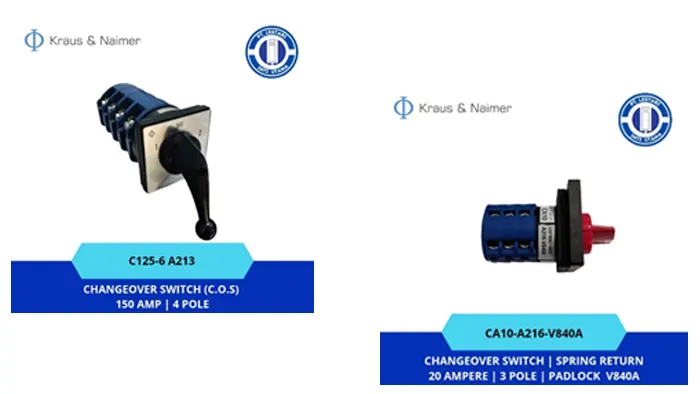
A selector switch is a manually operated electromechanical device used to choose between multiple machine states or circuit paths, making it essential for industrial panels, HVAC systems, and laboratory equipment. PT. Lestari Inti Utama as a sole distributor for Kraus & Naimer switch selector has many varieties of switches.
Unlike push buttons, selector switches maintain their chosen state until deliberately changed, ensuring clarity and safety in operations.
At PT. Lestari Inti Utama, we can custom order any switch selector according to customer’s needs.
What Is a Selector Switch?
- Definition: A selector switch allows operators to open, close, or redirect electrical circuits by rotating a knob, lever, or key.
- Core Function: Used for state selection (e.g., Auto/Manual, Forward/Reverse, Local/Remote).
- Difference from Push Buttons: Push buttons are momentary; selector switches maintain a state until changed.
Key Components
- Actuator: Knob, lever, or key that the operator turns.
- Contact Blocks: Electrical portion, can be normally open or closed.
- Mounting System: Fits standard panel cutouts (commonly 22 mm or 30 mm).
At PT. Lestari Inti Utama, we have hundreds of stocks to serve our customers better.
Types of Selector Switches
| Type | Features | Applications |
| Rotary | 2–12+ positions, robust, intuitive | Motor starters, HVAC, PLC panels |
| Key-lock | Prevents unauthorized changes | Safety-critical systems |
| Illuminated | Built-in LED for visibility | Low-light environments |
| Multi-pole cam | Handles multiple circuits, higher current | Heavy-duty industrial machinery |
| Digital | Integrated with smart I/O modules | Logging, compliance, audit trails |
Technical Specifications
- Pole Count: 2-position (ON/OFF), 3-position (Hand/OFF/Auto), or multi-pole.
- Electrical Ratings: Commonly 10–12 A at 240–690 V.
- Ingress Protection: Ranges from IP20 (basic panels) to IP65/IP67 (washdown or hazardous areas).
- Temperature Range: Industrial-grade models operate from -40 °C to +80 °C.